Posts

Showing posts with the label PC Modding

DIY Luggable Pentium
Image
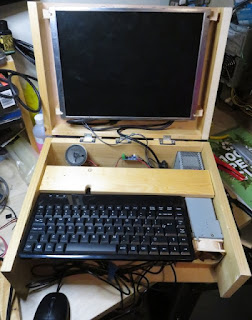
 Ages ago, I bought a Socket 5 Pentium via Ebay.  I had mounted it in a DIY wooden case just so I could use it, but it was always a bit of a pain to fish out a 4:3 monitor, PS/2 keyboard and mouse and connect it all up. So for a long, long while I have had the idea of making it into a 'luggable' machine.  Finally today, I have made it a reality.   I had an ancient monitor kicking around that ran off a 12V input and I had tested powering it from an ATX PSU.  I dismantled it with the idea of using it for video and audio.  Unfortunately while removing it from its case, I managed to damage the cable connection for the speakers, so then I had to dig out an old speaker from a box of scrap. Annoyingly, this motherboard did not have an amplified output - only a line out.  So I bought a cheap amplifier module that works off 5V so I could power it off the PSU's 5V line.  This has led to an annoying amount of noise in the output - I suspect from the PSU. The...

NAS 'Case'

Image
I dun maed a frame for my home NAS machine.  It's been sitting as an untidy pile of connected components for just too long, so I finally did something about it. And here it is in-situ under the stairs: It's made from plywood off-cuts - the back from an old cupboard and the sides and drive supports from when I put boards up in the loft. I tried holding the PSU in with battens, but the glue wouldn't hold and they split when I tried using screws.  So instead I sank dowels into the plywood.  You can see four in the photo (two on the back board and two on the side), but there's another two on the back board holding the PSU's weight from underneath.  Rather improbably, it's actually quite a strong fit and the only way to get the PSU out is to slide it upwards. The bar across the front hooks onto two dowels (one from each side-board) so I can easily get at the drives to replace any failures.  It's got corrugated card on it to dampen vibrations and provide some grip...

Wall-mounted PC: Finished!

Image
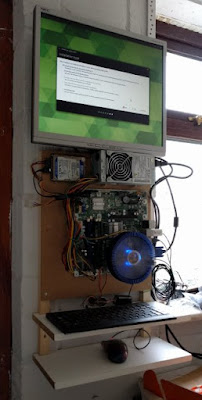
The rest of the project went so smoothly, there's very little to add to the previous post ! The standoffs for the motherboard screwed right into drilled holes in the MDF without needing glue. The HDD and PSU are held to the board by twisty-ties that go through holes in the board.  I didn't trust twisty-ties to hold the PSU's weight though, so I drilled holes for a couple of dowels and glued them in.  The PSU rests on top of them nicely with the twisty-ties stopping it from falling forwards. The shelves are furniture board off-cuts which are screwed to the battens from behind.  Amazingly, I managed to cut accurately enough that they fitted really snugly to the battens.  There is a bit  of give if you press them, but seeing as they're not going to hold anything of real weight I left them as they are. I'm not entirely happy with the cable-mess.  A little more forethought could have had them tucked behind the MDF board, but meh. I've installed...

Wall-Mounted PC: Progress!

Image
The actual physical progress I have made is a monitor wall-mount made from battening and MDF. See the monitor hanging magically with no visible support! I made a frame for the back of the monitor from 3 pieces of 6mm MDF: I knew the bolts I had could only go in so far before I hit resistance (presumably from the internal components).  As far in as I was confident tightening them would leave ~9mm gap.  So I figured 12mm of MDF would be fine. WRONG.  It turns out you have far less wiggle-room on these things than I thought. So I had to countersink them through the outer layer.  That gave me the fear though because the outer layer would be the only thing really holding the monitor onto the wall bracket.  So I decided to glue the layers together as well as having the bolts.  It took a couple of tries to get the countersinking to the right depth, but it got there! And before I did anything else, I tested that the panel from the wall-brac...

PC Shelf 'Case'

Image
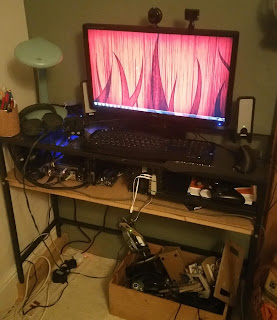
TLDR: I made a shelf for my desk and mounted my PC components on it.  Lookit! Having changed my PC desk a while ago, I've been growing gradually more annoyed at my tattered cardboard PC case sitting as an eye-sore in plain view of the whole living room.  The hard drives were hanging loose and the cooler radiator was balanced precariously on top. After much thought, I decided to add a shelf to my PC desk.  That way the PC could be off the floor, and the components could show through the glass desk-top.  Fixing a shelf to the metal box-section desk frame would not be easy, but I decided on drilling holes through the frame and bolting the shelf to it. Making the MDF shelf (with some battening to keep it rigid) was fairly easy.  Drilling the holes in the frame was a pain in the backside.  I should really invest in some proper drill bits for metal.  Eventually, after realising my M4 bolts were too short to fit through the wooden battens, I dug out ...

STEERING WHEEL!!!

Image
I dun made a steering wheel!!! I used the Teensyduino board and software.  The sketch software was an example provided with the teensyduino installer.  I tweaked it to cut down the 6 axes and 32 buttons to 1 axis and 2 buttons.  I needed to do that because without being wired up, the extra axes produced a bunch of random values, and the buttons randomly triggered. I have yet to test it in earnest.  I suspect it will fall apart in short order.  However, I have learned a lot by making it, so I should be able to make a better one if that happens.

Computation Server for under £1000

I was daydreaming and wondering what it would cost to get a top-of-the-range processing server with normal desktop components.  Then I set myself the challenge of putting together a shopping list for a powerful computation machine (to do video transcoding, for example) for under £1000. Obviously, Core i7 processors are out - they're fast, but very expensive. For fast computation, you want plenty of RAM (no slooow HDD I/O), but enough hard drive storage for decent backups of large amounts of raw data. So here's the shopping list: Qty        @ subtotal Mobo 1 £89.99 £89.99 from Novatech CPU 1 £159.98 £159.98 from Novatech RAM 1 £229.19 £229.19 from Crucial Graphics 1 £19.99 £19.99 from Novatech HDD 5 £54.98 £274.90 from Novatech CPU Cooler 1 £32.99 £32.99 from Novatech PSU (1000W) 1 £169.99 £169.99 from Novatech Total £977.03 I probably went a bit overboard with 7.5TB of storage (6TB with RAID 5), but feh. I haven't included shi...

XBox 360 Red Ring of Death

My brother bought a job lot of busted XBox 360s and recently gave up trying to fix them.  I have stepped into the breach and decided to show these machines who is boss. At the moment, it looks like I might even be able to fix one as well. :) I tried replacing the thermal compound , but to no avail. Then, I found this article , which seemed a little extreme.  However, to test it out, I tried firing up the XBox while leaning heavily on the CPU heatsink.  Lo and behold, the RROD had disappeared! So tomorrow, I am off to a hardware store to pick up some nuts, bolts and washers to properly squeeze this processor back down.  I'll update with how it goes... UPDATE: Well, I busted it.  Now it shows a different error code.  I suspect I tightened the bolts too much and the stress on the motherboard broke more connections. I feel like a ham-fisted dumb-ass.

Potential Cause of Persistent Crashes

I've been concerned for a while that my cardboard case doesn't properly support the weight of my graphics cards. I've experienced persistent freezes and spontaneous resets under Ubuntu, and thought it was a driver issue. This morning, I had crashes in Ubuntu 10.04LTS, 11.10 AND Windows 7.  When I nudged one of the graphics cards up and rebooted, Windows 7 was fine. I have now added more support for the graphics cards.  11.10 still freezes.  So far 10.04LTS still going strong.  Haven't tested Win7 yet.

Cardboard Server 'Rack'

Image
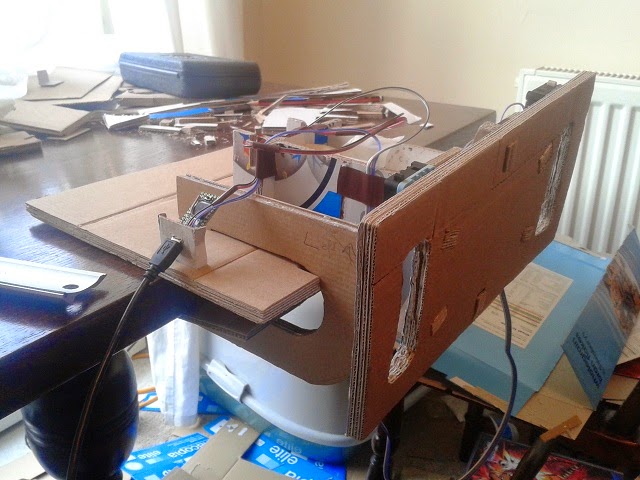
A while back, I set up a minecraft server. Having had previous internet-visible machines hacked, I decided to have the server sitting behind a dedicated router (actually an old P3 machine). The router has teh smrts, which gives me more confidence of the server's security. The real reason I'm mentioning it is the case I made for it. 'Case' is really a misnomer, as you can see, but it has allowed me to have two PCs in a small space, and taking up only one plug socket between them. It's made of many smallish pieces of corrugated cardboard, stuck together in three layers (with the corrugations at right angles from one layer to the next). This allowed me to use up some old packaging, while also providing a fairly rigid and strong sheet material to mount the components on. The motherboards are fixed to a vertical sheet, which is mounted on a horizontal base sheet. The end sheets are pretty much just to keep the vertical sheet upright, but one end also helps ...