Posts

Triangle Tree for Terrain

Image
As part of my ongoing experiments into semi-procedural terrains, I decided to have a play with a splitting-triangle tree.  It took me a couple of hours, but I got a simple triangle-splitter working. It's another example of why I love Python for throwing together a quick experiment. The grid is way too regular for my liking, so I guess the next thing would be to get it to split in a non-regular way (whilst making sure that each individual triangle always splits the same each time, so the splitting doesn't change if you leave an area and come back.)
Shadowy Godot Experiment

Image
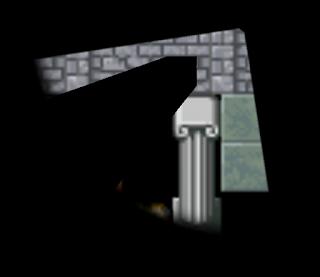
I have spent all of 2 hours with the Godot Engine , and I LOVE IT. I was reluctant at first, because of all the time I've invested in figuring out Unity and sorting things in that.  So when I wanted to play around with a 2D light/shadow game, I started searching for how to do it in Unity. No immediate answers popped up at me (maybe I didn't know the right key terms), but there were plenty of posts about writing shaders to achieve it.  There were some posts about plugins which only work with Unity Pro (but admittedly, they were quite old).  And a really old post where someone had written their own plugin. This blog post  was particularly interesting as it outlined an algorithm for nice-looking shadows. However, I wasn't looking for how to do beautiful shadows.  I was looking for a way of experimenting with them. So I searched for 2D shadows in Godot.  And I found a very brief chain about the example project showing exactly how to do it. Sure, I ...

Island Terrain Generation Part 2

Image
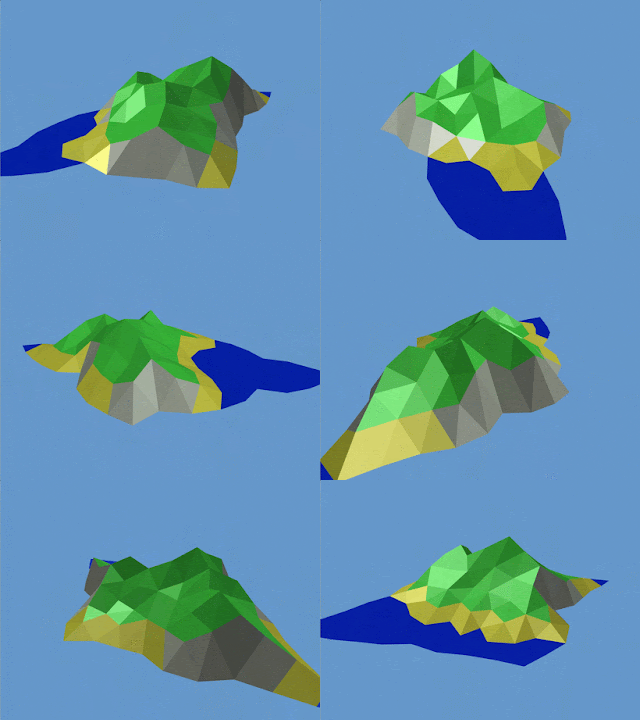
This is a follow-up to a previous post on Island Terrain Generation . I actually had to re-write a lot of the algorithm from scratch, which I'll explain in a bit, but here it is: Instead of triangulating an outline poly, I decided to generate a regular flat triangle mesh, rotate randomly chosen edges, then relax the mesh.  This made the island fully procedural, rather than the semi-procedural generation I wanted.  However, it was necessary to make progress. Once I'd generated the distorted triangle mesh, I could randomly select a point on the mesh to be the peak of the island, and generate ridges/troughs growing out from that peak.  The ridges can split into multiple after a few steps, but they have to stop before they hit the edge of the mesh. Once the ridges are grown, any untouched points can have elevations assigned according to how high their neighbouring points are. I also force all the edge points to have elevation zero. Then, I assign a colour to e...

Vanity Project: System Emulator

Image
Having played with pico-8 (which I love!), I was wondering about creating an emulated computer system from scratch.  I couldn't really figure out what the point would be.  A demonstration system for secondary students? - probably too complicated.  A competitor to pico-8? - just why? pico-8 is awesome. A replacement for LMC ? - probably too complicated. A nostalgia trip about tinkering with the Commodore 64 back in the day? - maybe. Just for fun? - ... Well I eventually accepted the idea that I am actually crazy enough to enjoy putting together a virtual system for no other reason that it might be interesting to try.  With that in mind, I chose to do it in C# because I hadn't used MonoDevelop in ages.  (Writing a VM which runs inside the .NET VM does feel a little VM-ception though). I decided to start from a 6502-style instruction set, with Load Immediate and such (although I'll probably pass on the more complicated addressing modes), but I though...

Island Terrain Generation

Image
I've been playing around with procedural terrain generation for literally years, and the paucity of large-scale successes has made me determined to celebrate small ones.  So, whilst this still needs a HUGE amount of work, here goes... In my recent coding, I've been exploring semi-procedural method for islands using python3.  Building on my python triangulator from the Before Times, I have managed to make this: Yes, it is currently pants. However, it is generated from the outline of the island and the ridge points, and if I apply a DeLaunay pass to the triangulation I am sure it will look a lot better. Also, a great deal of the work has been taken up by figuring out how to store the data in a structure which allows the kind of processing I want to do.  Refactoring this data structure is actually my next step, so I can build to more islandy-looking islands. But the signs are hopeful!

Paper Craft Chimera

Image
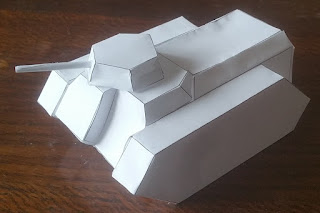
A Warhammer 40K club at school has inspired me to get modelling again.  My ragtag scavenger army for battling my brother will now grow to include some militia in the style of the Imperial Guard. I was given some Tempestus Scions for Christmas, and they are works of art.  I'm going to love building and painting them. However, Imperial Guard rely heavily on vehicles and I resent paying huge moneys for ancient models (looking at you, Chimera).  So I started to explore making my own Chimera-like APC. I made very low-poly models of each of the main parts (tracks, hull, turret) in Blender , then marked the seams and used UV Unwrap to make the net.  Exporting that as a .png meant I could print it out. Except...it'd all be the wrong size. So I imported the UV layout .png into Inkscape  and scaled it.  I made a rectangle of a known dimension (e.g. 100mm long for the base of the hull), and scaled the imported png to match.  Then I could print it the c...

Blender To Unity

Image
Today I have been working hard at texturing and modeling a cockpit for the dropship I made ages ago . The texture is really low-res, but it's exported from Inkscape , so I can boost that later if need be.  It's also a little bland in places, but I'm no artist - I'm proud of it. I also modeled a really basic cockpit and moved the camera inside.  Here's how it looks: Dull, huh? In the fullness of time, I'll make a texture for it, and model some instruments.  For now though, it's a huge leap forward for my meagre art abilities.